Proto-Protestants
Proto-Protestants
  • Home
  • FAQ
  • Clement of Rome
  • John Chrysostom
  • Basil the Great
  • Augustine of Hippo
  • Epistle to Diognetus
  • Hilary of Poitiers

John Chrysostom remains one of the early Church’s most beloved pastors and most luminous preachers—so renowned for the clarity and power of his sermons that he came to be remembered as Chrysostomos (“Golden-Mouthed”). Trained in Antioch’s exegetical tradition, he became famous for verse-by-verse preaching that grounded Christian doctrine and ethics directly in the biblical text. After meeting Bishop Meletius of Antioch, he began to withdraw from secular pursuits and give himself to Scripture and spiritual discipline; contemporaries even describe his baptism as a true turning point, an earnest renunciation of the world in order to serve Christ. He learned to read Scripture with close attention and to preach it with a rare ability to press the text into the conscience and the comfort of ordinary people. After years of ascetic discipline and then public ministry, he was unexpectedly called to serve as Archbishop of Constantinople—where his insistence on integrity among the clergy, simplicity of life, and care for the poor won many hearts. Again and again, his preaching drives confidence away from human achievement and back to God’s mercy—insisting that the believer’s standing before God is grounded in grace and received through faith. His preaching also provoked powerful enemies, resulting in his exile more than once. He died far from home, leaving behind a legacy of verse-by-verse homilies that still nourish the Church to this day.
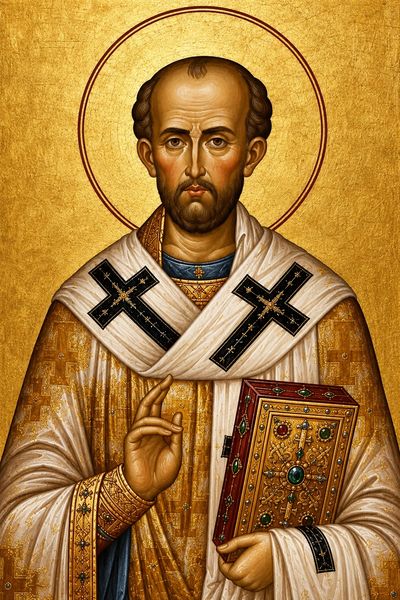
   John Chrysostom (ca. 347-407)

“The favors of God so far exceed human hope and expectation, that often they are not believed. For God has bestowed upon us such things as the mind of man never looked for, never thought of. It is for this reason that the Apostles spend much discourse in securing a belief of the gifts that are granted us of God. For as men, upon receiving some great good, ask themselves if it is not a dream, as not believing it; so it is with respect to the gifts of God. What then was it that was thought incredible? That those who were enemies, and sinners, neither justified by the law, nor by works, should immediately through faith alone be advanced to the highest favor. Upon this head accordingly Paul has discoursed at length in his Epistle to the Romans, and here again at length. ‘This is a faithful saying,’ he says, ‘and worthy of all acceptation, that Christ Jesus came into the world to save sinners.’

As the Jews were chiefly attracted by this, he persuades them not to give heed to the law, since they could not attain salvation by it without faith. Against this he contends; for it seemed to them incredible, that a man who had mis-spent all his former life in vain and wicked actions, should afterwards be saved by his faith alone. On this account he says, ‘It is a saying to be believed.’” [bold added]


John Chrysostom, Hom. in 1 Tim. 4 (on 1 Tim. 1:15–16), in NPNF1 13. 

Copyright © 2026 ProtoProtestants - All Rights Reserved.

Powered by

This website uses cookies.

We use cookies to analyze website traffic and optimize your website experience. By accepting our use of cookies, your data will be aggregated with all other user data.

Accept