Augustine of Hippo was a man whose mind could out-argue his rivals—and whose heart God conquered all the same. Restless, ambitious, and haunted by the question of truth, he chased pleasure and prestige until the Lord Jesus Christ broke through his pride by the words of Scripture and the patient prayers of his mother, Monica. Converted in Milan under the preaching of Ambrose, Augustine returned to North Africa and became a pastor and then bishop of Hippo, spending the rest of his days pouring himself out for the Church: preaching, writing, praying, and contending against error with a shepherd’s urgency. In Confessions he lets you watch grace at work in real time; in The City of God he lifts your eyes above collapsing empires to an unshakable kingdom. Throughout his works, Augustine treats the canonical Scriptures as the Church’s final and supreme authority, directing the Church back to them as the highest court of appeal. That such language comes from the most influential Western Church father—centuries before the Reformation—demonstrates that Scripture’s unique authority was already being articulated in the ancient Church.
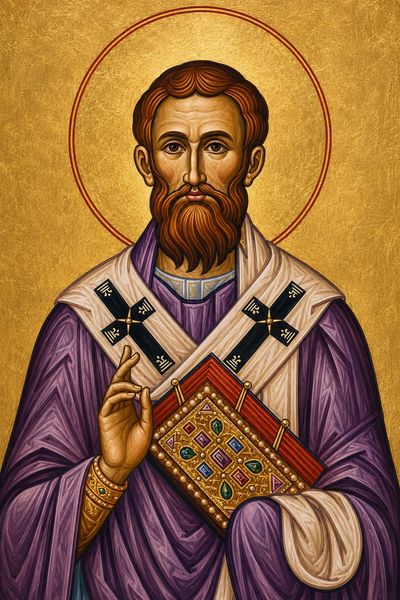
Augustine of Hippo (354-430)
“On such terms we might amuse ourselves without fear of offending each other in the field of Scripture, but I might well wonder if the amusement was not at my expense. For I confess to your Charity that I have learned to yield this respect and honour only to the canonical books of Scripture: of these alone do I most firmly believe that the authors were completely free from error. And if in these writings I am perplexed by anything which appears to me opposed to truth, I do not hesitate to suppose that either the manuscript is faulty, or the translator has not caught the meaning of what was said, or I myself have failed to understand it. As to all other writings, in reading them, however great the superiority of the authors to myself in sanctity and learning, I do not accept their teaching as true on the mere ground of the opinion being held by them; but only because they have succeeded in convincing my judgment of its truth either by means of these canonical writings themselves, or by arguments addressed to my reason. I believe, my brother, that this is your own opinion as well as mine. I do not need to say that I do not suppose you to wish your books to be read like those of prophets or of apostles, concerning which it would be wrong to doubt that they are free from error. Far be such arrogance from that humble piety and just estimate of yourself which I know you to have, and without which assuredly you would not have said, “Would that I could receive your embrace, and that by converse we might aid each other in learning!” [bold added]
Augustine, Ep. 82.3 (to Jerome), in NPNF1 1.
“Now let the proud and swelling necks of the heretics raise themselves, if they dare, against the holy humility of this address. You mad Donatists, whom we desire earnestly to return to the peace and unity of the holy Church, that you may receive health therein, what have ye to say in answer to this? You are wont, indeed, to bring up against us the letters of Cyprian, his opinion, his Council; why do ye claim the authority of Cyprian for your schism, and reject his example when it makes for the peace of the Church? But who can fail to be aware that the sacred canon of Scripture, both of the Old and New Testament, is confined within its own limits, and that it stands so absolutely in a superior position to all later letters of the bishops, that about it we can hold no manner of doubt or disputation whether what is confessedly contained in it is right and true; but that all the letters of bishops which have been written, or are being written, since the closing of the canon, are liable to be refuted if there be anything contained in them which strays from the truth, either by the discourse of some one who happens to be wiser in the matter than themselves, or by the weightier authority and more learned experience of other bishops, by the authority of Councils; and further, that the Councils themselves, which are held in the several districts and provinces, must yield, beyond all possibility of doubt, to the authority of plenary Councils which are formed for the whole Christian world; and that even of the plenary Councils, the earlier are often corrected by those which follow them, when, by some actual experiment, things are brought to light which were before concealed, and that is known which previously lay hid, and this without any whirlwind of sacrilegious pride, without any puffing of the neck through arrogance, without any strife of envious hatred, simply with holy humility, catholic peace, and Christian charity?” [bold added]
Augustine, On Baptism, Against the Donatists II.3.4, in NPNF1 4.
“As regards our writings, which are not a rule of faith or practice, but only a help to edification, we may suppose that they contain some things falling short of the truth in obscure and recondite matters, and that these mistakes may or may not be corrected in subsequent treatises. For we are of those of whom the apostle says: “And if you be otherwise minded, God shall reveal even this unto you.” Such writings are read with the right of judgment, and without any obligation to believe. In order to leave room for such profitable discussions of difficult questions, there is a distinct boundary line separating all productions subsequent to apostolic times from the authoritative canonical books of the Old and New Testaments. The authority of these books has come down to us from the apostles through the successions of bishops and the extension of the Church, and, from a position of lofty supremacy, claims the submission of every faithful and pious mind. If we are perplexed by an apparent contradiction in Scripture, it is not allowable to say, The author of this book is mistaken; but either the manuscript is faulty, or the translation is wrong, or you have not understood. In the innumerable books that have been written latterly we may sometimes find the same truth as in Scripture, but there is not the same authority. Scripture has a sacredness peculiar to itself. In other books the reader may form his own opinion, and perhaps, from not understanding the writer, may differ from him, and may pronounce in favor of what pleases him, or against what he dislikes. In such cases, a man is at liberty to withhold his belief, unless there is some clear demonstration or some canonical authority to show that the doctrine or statement either must or may be true. But in consequence of the distinctive peculiarity of the sacred writings, we are bound to receive as true whatever the canon shows to have been said by even one prophet, or apostle, or evangelist. Otherwise, not a single page will be left for the guidance of human fallibility, if contempt for the wholesome authority of the canonical books either puts an end to that authority altogether, or involves it in hopeless confusion.” [bold added]
Augustine, Reply to Faustus XI.5, in NPNF1 4.
We use cookies to analyze website traffic and optimize your website experience. By accepting our use of cookies, your data will be aggregated with all other user data.