Proto-Protestants
Proto-Protestants
  • Home
  • FAQ
  • Clement of Rome
  • John Chrysostom
  • Basil of Caesarea
  • Augustine of Hippo
  • Epistle to Diognetus
  • Hilary of Poitiers
  • Ambrose of Milan
  • Polycarp of Smyrna
  • Cyril of Alexandria
  • Irenaeus of Lyons
  • Jerome of Stridon
  • Marius Victorinus
  • Origen of Alexandria
  • Contact

Ambrose of Milan was one of the most important bishops and theologians of the early Church. Born into a prominent Roman Christian family, he was trained in law and public service before unexpectedly being chosen as bishop of Milan in 374. Though still a catechumen at the time, he quickly became known for his courage, learning, and pastoral leadership.

As bishop, Ambrose played a major role in defending Nicene Christianity against Arianism and in shaping the public life of the Church in the late Roman Empire. He was a gifted preacher whose sermons deeply influenced Augustine, whom he later baptized. Ambrose also wrote widely on Scripture, Christian morality, the sacraments, and the person of Christ, leaving a lasting mark on Western theology.

Remembered for his eloquence, firmness, and devotion to the authority of God’s Word, Ambrose stands as one of the great Latin Fathers of the Church. His legacy endured not only through his writings and hymns, but also through his example of episcopal courage and pastoral care.
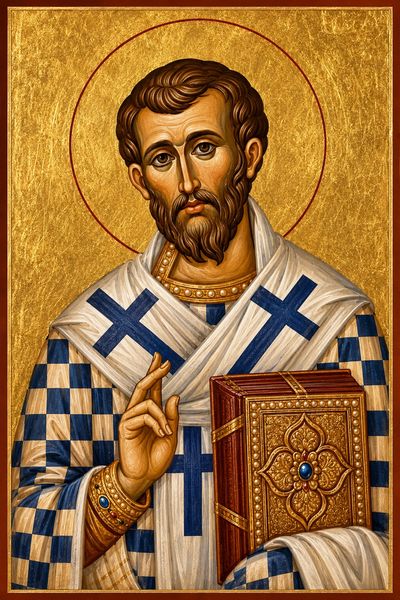
   Ambrose of Milan (c. 339–397)

“Ye behold the mysteries, ye behold the grace of Christ, and the grace of the Holy Spirit, which is conferred in some sort fortuitously; forasmuch as every one is not justified by the Lord by reason of his works, but by reason of faith. ”


Ambrose, Exhortatio Virginitatis 7.43, PL 16:349A; trans. Finch, 220. [bold added]

“Therefore our Lord God also tempers judgment with mercy. For which of us can stand without divine compassion? What can we do that is worthy of heavenly rewards? Which of us rises so high in this body that he lifts his soul so as to cling continually to Christ? By what human merit, then, is it brought about that this corruptible flesh should put on incorruption, and this mortal should put on immortality? By what labors, by what self-inflicted hardships, can we wash away our sins? The sufferings of this present time are unworthy in comparison with the glory to come. Therefore, the pattern of heaven’s decrees proceeds toward men not according to our merits, but according to the mercy of God.”


Ambrose, Expos. in Ps. 118, 20.42 (PL 15:1574). [bold added]

“Yet it has benefited me that I began to confess what I had been denying: I began to recognize my offense, and not to conceal my unrighteousness; I began to declare my unrighteousness against myself to the Lord, and you forgave the impieties of my heart. But this too benefits me: that we are not justified by the works of the Law. Therefore I have no ground on which I can glory in my works, I have no ground on which I can boast; and so I will glory in Christ. I will not glory because I am righteous, but I will glory because I am redeemed. I will glory not because I am free from sins, but because my sins have been forgiven me. I will not glory because I have been of benefit, nor because anyone has benefited me, but because Christ is an advocate with the Father for me, because Christ’s blood has been shed for me.”


Ambrose, De Jacob et vita beata, 1.6.21 (PL 14:607B–C). [bold added]

Copyright © 2026 ProtoProtestants - All Rights Reserved.

Powered by

  • Contact

This website uses cookies.

We use cookies to analyze website traffic and optimize your website experience. By accepting our use of cookies, your data will be aggregated with all other user data.

Accept